Showing posts with label year 10. Show all posts

Tuesday, 2 September 2014

Year 10 English Protest Unit - Harrison Bergeron

Ok, so for the past few weeks my Year 10 students and myself have embarked on a unit designed by various English bodies as an exemplar for the new Australian Curriculum syllabus. For those teachers who are interested, you can find the unit at http://e4ac.edu.au/units/year-10/index.html

Late last week, we started Activity 2 of Unit 3 which had students explore the short story Harrison Bergeron by Kurt Vonnegut. We also looked at a short film version of the text which can be watched on YouTube at http://youtu.be/-4-hEfqpxIg

After exploring this text, in the following lesson, students were required to write a blog post reflecting on our current political and social environment and to philosophise upon the concepts of equality, handicap and intelligence that are explored in the text. Is it a warning? Can we truly be equal? What does equality look like?

The blog posts were to be approximately 600 words in length and to be posted on our class Edmodo page. Students were then also encouraged to pass comment on other people's responses as a form of formative feedback. Many students initially struggled, as many were not use to the idea of 'thinking for themselves' or with the concept of 'there's no real right or wrong answer.' So in order to put my money where my mouth is, I volunteered to complete the task also.

However, there were conditions. I wasn't allowed to post my completed blog post on the Edmodo page in entirety (as they didn't want to have to compare my post to there's) and I had to submit my work by the same deadline.

So, to my delightful Year 10 students (and any other's who may be following my blog in the wider education community) here is my homework...


Reflection on Kurt Vonnegut's Harrison Bergeron

The year is 2014...and everyone is finally equal. Well, in order for that statement to be true, we would have to have a shared understanding of what equality is. So, what is equality? What does it look like? Is it something that can actually be attained, or is it some mythical creature like Big Foot which everyone swears is out there, but somehow we have no real evidence of seeing?

I think the theoretical notion of equality in itself is problematic. In order to define it, everyone needs to be on the same page as to what that definition is. But who decides what the standards are? And who decides who makes the decision? Is the definition of equality universal or is the definition subjected to variation between different cultures and societies?

When using the word equality, I think most people would define it as all individual having the same opportunities and treatment within society; or the same status. But when trying to establish equality, a set of benchmarks need to be made. It is from these benchmarks that a person can be valued as either being privileged or underprivileged in a particular area of there being. So for example a person who has no home or job is not being seen as equal to a person with a home or job. However, our society has determined that the desirable outcome is the latter as opposed to the former. The person without the job or home is classified as underprivileged in our society, as we value these two possessions. When a person is seen to be underprivileged, we typically offer support in order for this person to be 'equal'.

This is where I go back to how equality is problematic. How equality is distributed seems to be directly influenced by what society values. Or more precisely, what the people in power in our society value. If those in power value the marriage of man and woman, then they would allow the opportunity for all men and women to marry. However, this does not demonstrate those in power valuing marriage as a whole, as they are not giving same sex marriages the same level of value or equality as heterosexual marriage.  

When reading Harrison Bergeron, I kept thinking of Orwell's Animal Farm, and the commandments of the pigs. Those in power create a set of rules in order for all animals to be 'equal', but they then kept amending the rules to benefit some over others. In the end it can be summarised by this image:
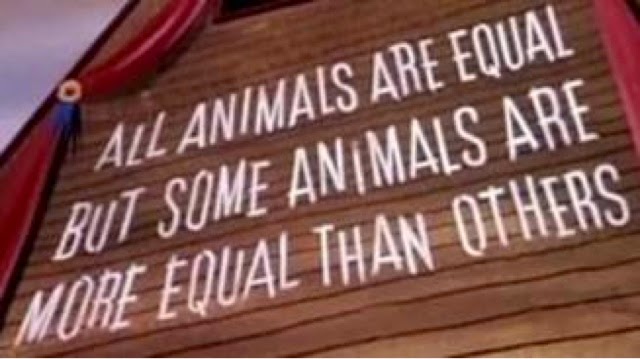

In Harrison Bergeron, they had the 'Handicap General'; a person who had ultimate power to oversee and ensure that society was 'equal'. By but empowering an individual to do this, in itself creates inequality.

The year is 2014, but we aren't equal. And who's to say that equality would be better in the long run? To truly create equality it would mean that some individuals would be better that current circumstance, but then others, in theory, would be worse off. I the short story, Vonnegut depicts how those who are 'better' are handicapped and impaired to try and make them more equal to those who are disadvantaged. Here he shows how intellect and knowledge is seen as dangerous, and those who possess these qualities could shift the balance of power.

Harrison Bergeron demonstrates how equality doesn't demonstrate justice, and how sometimes in the attempt of creating an equal world it could be detrimental to society. And through Vonnegut's story, we can gain an understanding of just how subjective the concept of equality actually is.

What are your thoughts? Can we ever be truly equal? How would you define equality?

Tuesday, 22 July 2014

Yr 10 English Shakespeare and Romeo & Juliet

Hi all,

I thought I would start by adding some YouTube videos and such for you to peruse  at your own leisure.


Enjoy.

Mrs P

Thursday, 19 June 2014

Yr 10 English Persuasive Print Media

Hi All,

I apologise for not posting as often as I would like.

Here are some resources to assist you in creating of your print media texts:

The Art of the Open Letter  - This blog post shows some examples of open letters and some tips on writing your own.

How To Construct an Editorial - The guy on the video might not have the most engaging voice, but what he says is worth listening to.


How to Write an editorial - I would recommend watching this video on mute, unless old timey music is your thing. Some very useful writing tips though.


How to write letters to the editor - Another short you tube video about the construction of this text type.


Smart Tips for writing a great feature article - This doesn't appear to have any sound, so put on your favourite tunes while looking/reading the hints and tips.


How To write a Feature Article - May seem like deja vu, but the gut from the first video again explains the features and language devices of this text form.


Rhetoric devices - Here's a vid made by some students demonstrating there understanding of some rhetorical (persuasive) devices. Contains clips from popular movies so quite engaging.


BONUS ROUND!

What Aristotle and Joshua Bell can teach us about persuasion - Here's a TedEd video explaining the theories developed by Aristotle about persuasion or rhetoric. This hasn't been covered in class, but it is great literary theory and metalanguage you can using moving into your ATAR courses.


Hopefully this is enough to help you along the way. If you need more support, leave a comment below or email me direct.

Happy Writing.

Mrs P

Wednesday, 14 May 2014

Year 10 Travel Blogging

Hi All,

Here is a copy of some resources we have covered in class to help you along with your blog writing.


Getting serious about travel blogging


Come back again soon for more updates and resources.

Mrs P

Friday, 5 April 2013

Year 10 English Gothic fiction essay

Hi All,

Here is the example intro written in class today.

TRUE!... This is the opening line of Poe's The Tell tale Heart. Within this text a variety of language conventions are used to construct the narrator of the text. Poe manipulates  these conventions to create a character that is interesting to the reader. The Tell Tale Heart recounts the events of a murder committed by the nameless narrator, and their inner debate of their sanity. Therefore, it is Poe's use of language devices that gives the reader insight into the mad and manic mind of the texts narrator.

Happy writing.

Mrs P.

Tuesday, 19 March 2013

Year 10 English Investigation

Hi All,

Here is a copy of the portfolio requirements.


Gothic Fiction investigation:
Section 1:
You are to choose a minimum of two activities from Column A and two from Column B to complete for marking.
The activities in Column A have a writing focus and the tasks in Column B are more visual and/or creative in focus.
Column A
All activities a minimum of 500 words
Column B
Book review  on either The Tell Tale Heart or The Red Room
New book cover for any text extract.
Extended response – To what extent are the conventions of Gothic literature present in modern fiction texts like Twilight.
Story board/comic version of the extract from Dracula  or Frankenstein
A diary entry or letter from Rick’s point of view explaining his thoughts and feelings during the extract of The Walking Dead.
Design a comic book version of the Dracula extract.
Feature article on Vampires “Coming out the coffin” as spoken about in Dead Until Dark
Create a movie poster for the film version of A Tell Tale Heart.
A story OR journal entries written from Robert Neville’s perspective in I Am Legend.
Create/Design an infographic/poster on Dracula and/or vampires
Detailed description of a vampire, vampire lore, and their strengths and weaknesses.
Create a pamphlet on zombies and how to protect yourself from attack
Rewrite the ending to give another conclusion to the story of A Tell Tale Heart.
Create a board game based on The Red Room.
Write an interview with the character in The Tell Tale Heart OR an interview that asks people their opinion on gothic texts.
Create a collage on the themes and major ideas in A Tell Tale Heart.
Rewrite a section of Frankenstein imaging it was happening today, not last century.
Make a short film based on the novel or a section of it.

Section 2:
Complete the following activities relating to The Tell Tale Heart and The Red Room.
1.      Comparison chart of the main aspects of each story
2.      The Factors of Fear
3.      Language and Atmosphere
4.      Identifying gothic conventions in The Red Room
5.      Extended response Tell Tale Heart narrator.

We will be reading The Tell Tale Heart and The Red Room, early next week. But you are more than welcome to read them now to complete your selections.

Happy writing.

Miss F

Thursday, 14 March 2013

Year 10 English Gothic Fiction

Hi All,

Here are some important links and content for Gothic Fiction.


Conventions of the Gothic

Gothic elements include the following:

1. Setting in a castle. The action takes place in and around an old castle, sometimes seemingly abandoned, sometimes occupied. The castle often contains secret passages, trap doors, secret rooms, dark or hidden staircases, and possibly ruined sections. The castle may be near or connected to caves, which lend their own haunting flavour with their claustrophobia, and mystery.

2. An atmosphere of mystery and suspense. The work is pervaded by a threatening feeling, a fear enhanced by the unknown. Often the plot itself is built around a mystery, such as unknown parentage, a disappearance, or some other inexplicable event. Elements 3, 4, and 5 below contribute to this atmosphere.

3. An ancient prophecy is connected with the castle or its inhabitants (either former or present). The prophecy is usually obscure, partial, or confusing. "What could it mean?" In more watered down modern examples, this may amount to merely a legend: "It's said that the ghost of old man Krebs still wanders these halls."

4. Omens, portents, visions. A character may have a disturbing dream vision, or some phenomenon may be seen as a portent of coming events. For example, if the statue of the lord of the manor falls over, it may portend his death.

5. Supernatural or otherwise inexplicable events. Dramatic, amazing events occur, such as ghosts or giants walking, or inanimate objects (such as a suit of armour or painting) coming to life. In some works, the events are ultimately given a natural explanation, while in others the events are truly supernatural.

6. High, even overwrought emotion. The narration may be highly sentimental, and the characters are often overcome by anger, sorrow, surprise, and especially, terror. Characters suffer from raw nerves and a feeling of impending doom. Crying and emotional speeches are frequent. Breathlessness and panic are common.

7. Women in distress. As an appeal to the pathos and sympathy of the reader, the female characters often face events that leave them fainting, terrified, screaming, and/or sobbing. A lonely, pensive, and oppressed heroine is often the central figure of the novel, so her sufferings are even more pronounced and the focus of attention.

8. Women threatened by a powerful, impulsive, tyrannical male. One or more male characters has the power, as king, lord of the manor, father, or guardian, to demand that one or more of the female characters do something intolerable. The woman may be commanded to marry someone she does not love (it may even be the powerful male himself), or commit a crime.

9. The metonymy of gloom and horror. Metonymy is a subtype of metaphor, in which something (like rain) is used to stand for something else (like sorrow). For example, the film industry likes to use metonymy as a quick shorthand, so we often notice that it is raining in funeral scenes. Note that the following metonymies for "doom and gloom" all suggest some element of mystery, danger, or the supernatural.
 
wind, especially howling
rain, especially blowing
doors grating on rusty hinges
sighs, moans, howls, eerie sounds
footsteps approaching
clanking chains
lights in abandoned rooms
gusts of wind blowing out lights
characters trapped in a room
doors suddenly slamming shut
ruins of buildings
baying of distant dogs (or wolves?)
thunder and lightning
crazed laughter

10. The vocabulary of the Gothic. Here are some of the words (in several categories) that help make up the vocabulary of the Gothic 
 
Mystery
diabolical, enchantment, ghost, goblins, haunted, infernal, magic, magician, miracle, necromancer, omens, ominous, portent, preternatural, prodigy, prophecy, secret, sorcerer, spectre, spirits, strangeness, talisman, vision
Fear, Terror, or Sorrow
afflicted, affliction, agony, anguish, apprehensions, apprehensive, commiseration, concern, despair, dismal, dismay, dread, dreaded, dreading, fearing, frantic, fright, frightened, grief, hopeless, horrid, horror, lamentable, melancholy, miserable, mournfully, panic, sadly, scared, shrieks, sorrow, sympathy, tears, terrible, terrified, terror, unhappy, wretched
Surprise
alarm, amazement, astonished, astonishment, shocking, staring, surprise, surprised, thunderstruck, wonder
Haste
anxious, breathless, flight, frantic, hastened, hastily, impatience, impatient, impatiently, impetuosity, precipitately, running, sudden, suddenly
Anger
anger, angrily, choler, enraged, furious, fury, incense, incensed, provoked, rage, raving, resentment, temper, wrath, wrathful, wrathfully
Largeness
enormous, gigantic, giant, large, tremendous, vast


Links to the text extracts:

Dracula: Dracula Chapter 1
Frankenstein: Frankenstein Chapter 5
Twilight: Twilight extracts
Dead Until Dark: Southern vampires
I am Legend: I am legend
Interview with the Vampire: Vampire Chronicles
The Walking Dead: Walking Dead
The Red Room & The Tell Tale Heart: Wells & Poe

These text extracts are intended for educational use only.

Happy reading

Miss F

Thursday, 7 March 2013

Year 10 Documentary essays

Hi All,

Here is a copy of our whiteboard notes from today's session:

Intro:

  1. Can we really present the reality in an un-bias way?
  2. Texts are often used to persuade viewers to take on particular perspectives on various issues.
  3. Documentary films are texts which attempt to present themes and issues in a realistic way. They do not want viewers to feel they are bias.
  4. Documentaries such as Bowling for Columbine, Supersize Me, and Once Upon A Time in Cabramatta deliver a specific perspective on topics
  5. THESIS: Therefore, filmmakers use a variety of techniques in order for the audience to believe they are watching reality.
Body Para 1:
  1. Filmmakers use a variety of techniques in order for the audience to believe they are watching reality.
  2. emerge the viewer in action
  3. quote or example - Morgan spewing
  4. we share the experience and empathize.
    relate it back to our own experiences
  5. by making the viewer relate it adds to persuasive effect
Body Para 2:
  1. Similarly, filmmakers often use interviews to give the notion of an unbias perspective.
  2. more personal and appears less constructed
  3. quote or example - Cabramatta - families
  4. filmmakers edit sections of interview to use
  5. editing process manipulates the content
Body Para 3:
  1. Furthermore, filmmakers intentionally omit certain elements to create a bias towards a subject matter
  2. limits the scope on a subject matter.
    see topic in a specific way
  3. quote or example - Bowling for Columbine - focused on anti-guns and mass shootings
  4. creates a negative POV towards America and gun control
    doesn't show any positives
  5. by limiting scope viewers are forced to see one POV
Conclusion:
  1. reword thesis
  2. reword topic sentences
  3.   

Happy writing

Miss F.

Tuesday, 5 March 2013

Year 11 & 10 Essays

Hi All,

Well, we have reached our fist bout of essays. (Duhm Duhm Duuuuuuuhm!!!!) But it doesn't have to be all doom and gloom.


The following words and techniques have been thrown left, right and centre at you: minties, thesis statement, topic sentence, grabbers...

Here is your first port of call for essay writing. I have included for your downloading pleasure, a few of the resources we have been looking at in class to help develop your essays. Remember, your final copy is to be hand written.  This gives you practise in the writing skills needed for your examinations.

Links:
Essay writing framework Year 10-12
Writing the Ultimate essay

Don't forget to check out my YouTube Channel for some helpful vids on essay writing also.

More links added soon.

Cheers

Miss F

Apology

Hi everyone,

I wanted to apologize for the lack of content this year so far. It appears that a lot of posts haven't been published on the web, which must be a fault at my end. I will rectify this as soon as possible  and be posting content you need very soon. In the meantime, check on the school 'Get Work' drive for worksheets and task sheets you may need.

Thanks.

Miss F